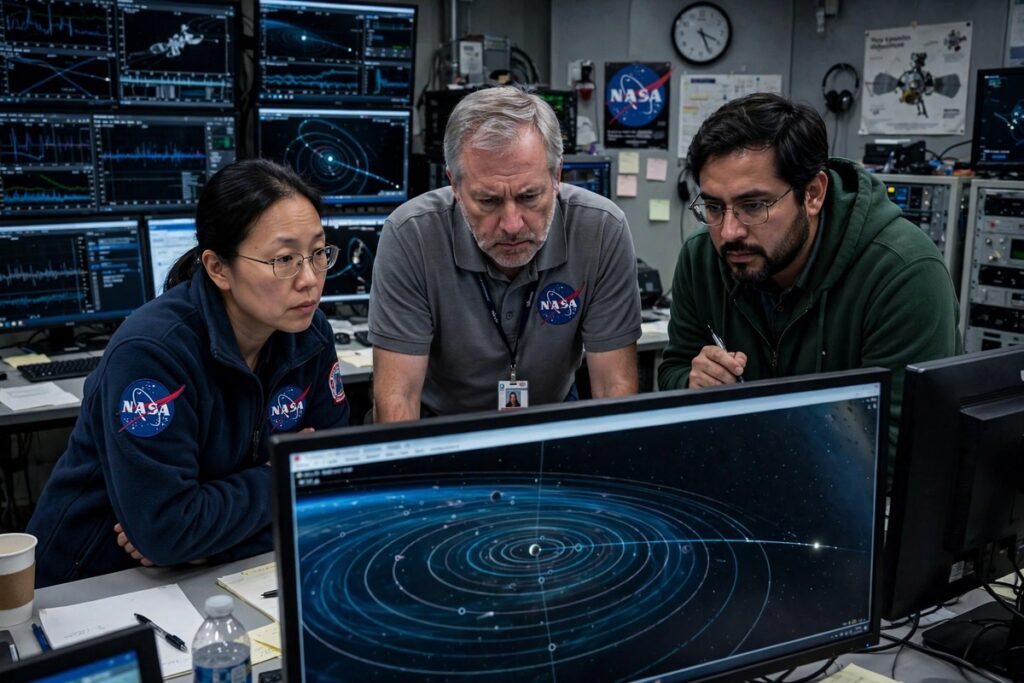
A One-Light-Day Milestone
NASA's Voyager 1 is set to reach a distance no human-made object has reached before: one full light-day from Earth. The milestone arrives Wednesday, November 18, at 5:16:07 a.m. Eastern, when the probe will be 16.094 billion miles away. At that distance, a radio signal traveling at the speed of light needs 24 hours to cover the gap. A command sent from Earth would require another full day before mission control could receive a reply. That is less like live chat and more like mailing a question to the stars. The spacecraft's distance turns even routine operations into an exercise in patience.
Voyager's Long Road Out
Voyager 1 launched in September 1977, when Jimmy Carter was president and personal computers were only beginning to reach consumers. It passed Jupiter and Saturn before entering interstellar space in 2012. Voyager 1 and Voyager 2 are the only spacecraft operating beyond the heliosphere, the vast protective bubble created by the sun's particles and magnetic fields. Voyager 2 reached interstellar space in 2018 after visiting Jupiter, Saturn, Uranus, and Neptune. Both probes carry matching Golden Records containing greetings, music, sounds, images, and diagrams from Earth, effectively serving as time capsules in case either machine is ever found.
Mission Control Meets the Waiting Game
Voyager 1 continues moving at roughly 38,000 miles per hour while returning science and engineering data. Its operating instruments measure the magnetic field, surrounding pressure, dust, plasma waves, and galactic cosmic rays in a region no other operating spacecraft has reached. Engineers are carefully rationing the probe's dwindling electrical power. NASA's Jet Propulsion Laboratory built and still operates the spacecraft, while the Deep Space Network maintains its extraordinary communications link. Keeping 1970s hardware alive at the edge of interstellar space requires ingenuity, because there is no nearby repair shop and no instant software update waiting in the wings.
NASA Invites Earth to Watch
NASA plans public events around the milestone, including a worldwide gathering Tuesday night and a mission update on November 19. The agency has invited people to flash Voyager's three-letter call sign, V-G-R, in Morse code using phones and flashlights, creating a symbolic wave of golden light around the planet. The Jet Propulsion Laboratory will also host a public discussion with scientists, engineers, and mission leaders about the condition of both probes, their continuing science, and the increasingly difficult work of operating machines built nearly half a century ago. The program is expected to include a question-and-answer session and a preview of an upcoming NASA+ Voyager documentary.
Let's talk about Voyager 1 and 2!
Join us Nov. 19 for a status update on the twin probes and a discussion of their unique mission. Plus, we'll have a Q&A session and a sneak peek at the upcoming NASA+ Voyager documentary. https://t.co/jo0hC3TaIL pic.twitter.com/VwAgAlqSIT
— NASA (@NASA) November 13, 2026
You can also use these cosmic odometers to follow the progress of Voyager 1 and 2. https://t.co/YlEiYqfTn3 pic.twitter.com/1Huz6G9KDu
— NASA Solar System (@NASASolarSystem) November 13, 2026
WE'D LOVE TO HEAR YOUR THOUGHTS! PLEASE COMMENT BELOW.