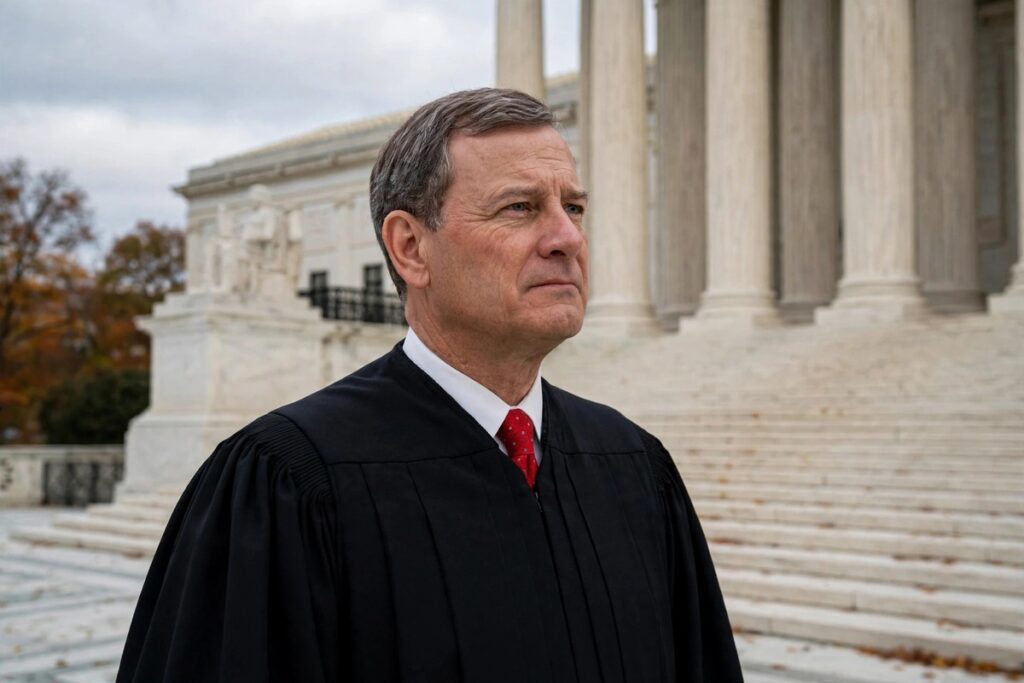
Roberts Freezes the Appeals-Court Clock
With the midterm elections less than a month away, Chief Justice John Roberts temporarily halted a Fourth Circuit order that threatened to force the Federal Communications Commission into an immediate ruling on political advertising rates. Roberts stayed the court’s October 7 judgment in Federal Communications Commission v. Sherrod Brown, et al., docket No. 26A476. The stay remains in effect pending another order from Roberts or the full Supreme Court. Brown and the other challengers have until 5 p.m. Eastern on Saturday, October 10, to respond. In plain English, the appeals court’s deadline is on ice for now. Court orders, it seems, can also be placed on a judicial timeout.
Did the Fourth Circuit Court of Appeals IGNORE a previous Supreme Court order allowing the Federal Communications Commission (FCC) to require a lower advertising rate for both political committees and candidates?!
Chief Justice John Roberts temporarily halted that lower federal… pic.twitter.com/7LdnQXWmHg
— Zack Smith (@tzsmith) October 8, 2026
A Temporary Win With Immediate Campaign Impact
The order is temporary, not a final ruling on whether the FCC policy is legal. It does, however, keep the agency’s current approach alive during the most expensive stretch of the campaign. That gives political parties and qualifying joint fundraising committees more time to operate under favorable advertising rates while the dispute continues. The result is a meaningful break for the Trump administration and Republican campaign organizations, which avoid having the policy disrupted by a judicial deadline. The Supreme Court has not settled the underlying argument. It has simply stopped the Fourth Circuit from forcing the next move before the justices are ready.
Chief Justice John Roberts gives FCC temporary win in fight over favorable campaign ad rate rules | Jack Birle, Washington Examiner
Chief Justice John Roberts gave the Federal Communications Commission a temporary win on Thursday in its legal battle over who is entitled to… pic.twitter.com/Y64vukeyes
— Owen Gregorian (@OwenGregorian) October 9, 2026
What the FCC Advertising Fight Is About
The dispute began with FCC guidance issued in March about the lowest unit charge broadcasters must offer during election season. The rule generally allows qualified candidates to buy comparable broadcast time at a station’s lowest rate during the 45 days before a primary and the 60 days before a general election. The FCC said that favorable rate could also extend to authorized committees involved in joint fundraising and to qualifying political-party coordinated expenditures. In a tight race, the difference between standard commercial rates and the lowest political rate can mean much more airtime for the same campaign dollars. That is a fairly important detail to discover after the advertising bills arrive.
Four Democratic Candidates Challenge the Guidance
Four Democratic candidates challenged the FCC’s interpretation: Sherrod Brown of Ohio, Jon Ossoff of Georgia, Roy Cooper of North Carolina, and Kristen McDonald Rivet of Michigan. Their campaigns argue that federal law reserves the lowest rate for candidates, and that extending the benefit to party organizations dilutes the advantage Congress gave candidates. The FCC opened a formal review and sought public comment in September. That review is now at the center of a procedural fight over whether the agency should be allowed to finish its work before the election or be pushed into a faster decision by the courts.
The Fourth Circuit’s Deadline Remains the Central Dispute
The Fourth Circuit ordered the FCC to finish the matter by noon Friday, accusing the agency of dragging out the process until judicial review might come too late to affect the election. The latest order raised a serious question about whether the appeals court had ignored an earlier Supreme Court order allowing the FCC to require a lower advertising rate for political committees and candidates. Roberts’s stay does not answer that question, and it does not decide whether the FCC’s policy will survive. For now, it preserves the existing rules and leaves the larger legal fight waiting for its next order.
"Not so fast" says Supreme Court as they issue a stay to appeals court order on LUR. https://t.co/ljwpiRcN5C
— Mississippi Association of Broadcasters (@MS_Broadcasters) October 9, 2026
WE'D LOVE TO HEAR YOUR THOUGHTS! PLEASE COMMENT BELOW.